Thursday, April 22, 2010

REVIEW: Carnival of Souls

Carnival of Souls
Director: Herk Harvey
Year 1962

Carnival of Souls is a dreamlike and surreal black and white horror film directed by Herk Harvey. This classic film really is beautiful, and with using black and white, we are given a moody piece full of fantastic imagery and tension filled horror. The style works to enhance the creepy tone of the film and helps us get lost in this sorted tale of mysteries unknown. Carnival of Souls haunting story starts out with a drag race gone bad, where our main character named Mary Henry, played by a ghostlike Candace Hilligoss, and her group of friends, end up getting into a horrible car accident as they tumble off a bridge and plunge into an icy river below.

Look out below!

It seems that there are no survivors, that is until hours later when Mary silently emerges from the waters completely unscathed, giving her rescuers quite a shock in the process. The shot of her coming out of the water and walking towards the camera is rather unsettling and it is a great introduction to the amazing imagery that we will be treated to later on in the film. Herk Harvey really sets the tone right off the bat and nothing ever seems real once the car accident occurs. We are left in a world that feels more like a dream, thanks to the haunting images that Mary's character is subjected to as the film moves along.

 Mary thought it would be a nice time for a swim.

After the accident, Mary is offered a job as an organist at a church in another town and her life seems to be coming together, other then the fact that she begins seeing strange figures appear out of thin air and then vanish as quickly as they came. Aside from believing she is losing her mind, Mary takes the job and sets off to her new home. On the way, we are treated to some unusual and creepy moments that really up the anti for what we are to experience as Mary's visions get stronger and bolder. The shots inside of the car as Mary drives along at night are shot with an expert eye and really look spectacular in this black and white format. There's always something classy about black and white and it sets such a nice tone for a haunting story like the one in Carnival of Souls.

It's no fun playing eye spy by yourself.

There's a few very special moments while she is driving the car that really stand out in my mind. We are given a morbid shot of a ghastly face watching Mary from the passenger side window. What makes this images so disturbing is the fact that the car is moving along at a good pace and the figure is just hovering there at the window. The way the man is lit also effects the impact of the shot. A glowing light shines up into his face as he locks eyes with Mary's character, causing her to scream out in shock. It's a great moment in the film and it's one of many.

Thanks for the ride lady!

One of the other memorable moments happen later on her journey to her new job. She is traveling down a pitch black deserted road, when a figure appears in front of her, staring at her with his dead eyes. She swerves to get out of the man's way and she manages to avoid contact with the strange man, but when checking in her rear view mirror, the man is nowhere to be seen. This chilling moment will not be the last time we see that apparition, because he seems to lead the charge in driving our main character crazy. He pops up many times throughout this film and the makeup effects for this creep of a character is subtly done, but quite effective in bringing about a disturbing looking antagonist.

What a creep.

What really sets the atmosphere in this film is its use of locations. A large portion of the film is shot at an abandoned amusement park named Saltair Pavilion that's located just outside Salt Lake City and this place is ripe for a ghostly tale to be told within its grounds. The visuals that it provides are astounding and the emptiness of the old place is quite eerie. Mary's character is strangely drawn to this location and she passes by it on her way to her new job. Curiously she investigates this intriguing place, not knowing why she is drawn to it or who may be drawing her there.
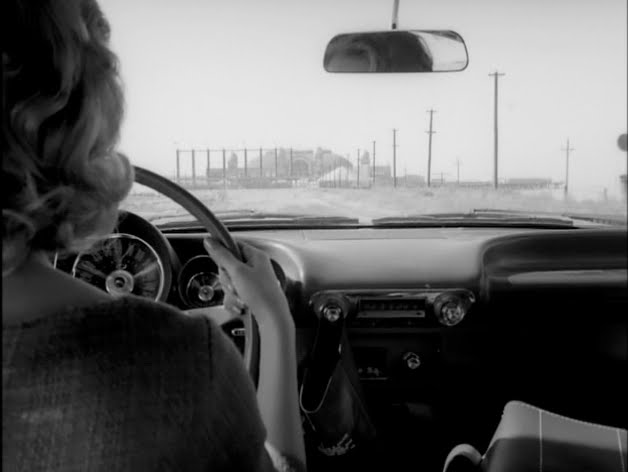
The eerie Saltair Pavilion can be seen in the distance.

The location of the Saltair Pavilion really is a beautifully obscure location and there are so many visually striking aspects to the parks grounds. Harvey takes full advantage of these stunning views in his filming and they really pay off for giving the overall haunting feel of the film's story. The parks grounds consist of grand ballrooms, strange fun houses, and broken down boardwalks, all located on a pier at the edge of an almost dried up lake bed. The feeling of death surrounds the place and encumbers it in a blanket of nostalgia provided by the many lives that have passed through this place over the years. The location has a history and you can feel it in every frame. It's wonderful to explore this unique location with Mary and it gives the film both a sense of mystery and adventure.
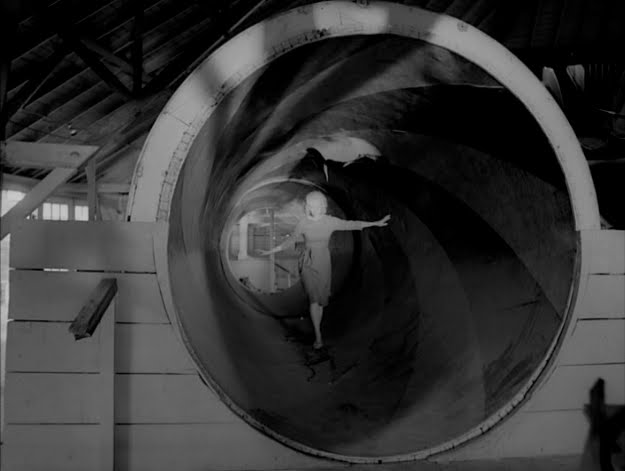
Just one of the many interesting things you'll find at Saltair Pavilion.

The sense of paranoia in Mary's character never really lets up as the film progresses. More and more, her visions begin to drive her mad as they show up at the most random times and even appear when she is surrounded by groups of people. The director never gives us too much information on whether this is all in her head or if there is in fact a sinister force after her, and I think the ambiguity of it makes it all the more interesting. What also makes this concept work is the fact that she is a fish out of water in a sense. She's new to the area and you can feel that uncomfortable feeling of not knowing what is around the next corner and the fact that she is out of her element and thrust upon a new world.

A sinister shadow enters the room.

At the peak of Mary's visions, she sees a great number of these strange people in groups watching her every move. The scene where Mary gets onto a bus and all of the passengers are ghouls is a remarkably memorable and unsettling scene, as the group of ghost-like beings stare directly at the camera and inherently at the audience as well.  It's effective and gives the viewer a chance to relate to Mary's perspective of always being watched by these voyeuristic beings. This maddening moment is quite compelling and gives us an out of body experience as we see through the terrified eyes of Mary.

Just another ordinary senior citizens bus trip to the casino.

There are a few instances where the director infuses a technique of warping the inside of the frame as if the film is slipping into a dream. Each time this happens, Mary's character is thrust into a world where she is not noticed by the other living inhabitants of the town. She screams at them to get their attention, but no one acknowledges her presence. Each time it happens it's a treat to behold as she desperately tries anything to draw the attention of the clueless locals. It is rather unique to be able to isolate the character yet still have them running through a crowded street. These sequences all have a very eerie quality to them and every one of them sticks out as a high point of the film. The director emphasizes this frustration that Mary goes through by not being heard, with a low angle shot of her running through town, desperate to get back to her apartment. The intensity of these shots are impressive and the acting by Candace is top notch.

A desperate shot of a sympathetic Mary as
she tries hopelessly, yet in vein, to be heard.

Eventually, the pull of the abandoned carnival becomes too much for Mary to resist and she journeys back to the haunting location, aimlessly walking its grounds as she searches for something not known to her. Once again, the location lends itself to a plethora of interesting angles and surreal vistas and through this second visit we are given a deeper glimpse into the amazing architecture of the place. The look of the film at this point has moved to a dismal array of shadows and vignette like compositions, stripping away the contrast of the films previous shots and projecting it in a dream like haze. These last few sequences are beautifully surreal and it feels as if this film has slipped into the cinematic time period that this carnival had once thrived in. It's a great throwback to those magical times, yet the director also adds a foreboding sense of doom in the way he shoots these long desolate shots of Mary wandering the grounds.

Mary's back again at the happiest place on earth.

As the director catapults us back in time, we are then presented with a morbidly dysfunctional flashback of sorts, of all of the strange people that Mary has met during the course of this film, as they dance across the ballroom in a strange waltz that really is entrancing. The movements of the dancers are both mechanical and ghostlike as they move to the rhythm of the old time music. One of the creepy moments of this sequence is when they all turn at the same time to look at Mary, then she is suddenly transported into the dance and is hand in hand with the main ghoul as he begins to howl in her face, spinning her around the room. It's creepy to say the least and a moment that definitely won't be forgotten come the movies closing credits.

The enchantment under the sea dance, minus Marty McFly.

The concluding scene is a terrifying one, with the group of dancers turning on our main character and chasing her out of the ballroom and out into the open terrain of the salt flats. It's hauntingly filmed and the style resembles that of the artistically surreal visuals of the 1920's German expressionist film, The Cabinet of Dr. Caligari. This ending brings all of the paranoia that proceeded in this eerie story to come crashing down in a heap of decayed bodies as the strangers huddle around Mary's fallen body and begin to smother her with every approaching inch as they gather in. You feel the weight of their bodies as they press inwards and it's excruciating to experience and quite visceral in its execution. It's a perfect ending to a classic film that relies on a heavy atmospheric tone to solidify its terrifying presence and impactful conclusion. I won't give away the overall meaning of the film and what we find out at the bitter end of this piece, but the director has hinted at the main characters inevitable destination for quite some time throughout the film. It's all executed to perfection and it's breathtaking to watch as each horrible event unfolds for Mary to react too.

Run Mary! Run home and don't stop till you get there!

Carnival of Souls is an instant classic and one that needs to be experienced at least once in your cinematic loving life. It brings so many memorable moments to the forefront of horror cinema and casts such a haunting spell on its audience that it overwhelmingly deserves the praise that it has received in its run over the years. The film is in a league of its own and it really delivers the atmosphere that this genre thrives on. I highly recommend this gem of a movie to anyone that loves haunting stories that bring a surreal visual eye to its composition and an uncompromised level of respect to its horror fused conceptualization. Check this flick out.

5 out of 5 stars     A Classic Horror Film That Will Haunt You.

REVIEW: Moon

Moon
Director: Duncan Jones
Year 2009

Moon is a spectacular film by first time feature director Duncan Jones. The film centers around an astronaut named Sam Bell, played by the intriguingly entertaining Sam Rockwell, who works on a remote base on the moon alongside a computer named GERTY, who is voiced by Kevin Spacey. His employer is a faceless company named Lunar Industries and they've commissioned him to a 3 year contract to extract an element called helium-3 from the lunar soil. He obtains the helium-3 material and ships it off to Earth, which helps generate a large portion of the worlds power supply. When we are introduced to Sam, he is nearing the last few days of his contract and is looking forward to heading back to earth to be with his wife and young daughter.

Sam Rockwell as astronaut Sam Bell.

The design and overall look of this film is based on some of Duncan Jones' favorite science fiction films from the 70's like Sean Connery's sci-fi high noon mirrored film Outland, the eco-friendly 1972 film Silent Running, and Ridley Scott's science fiction horror epic Alien. Duncan lovingly blends all of these visual concepts and tonal themes and presents them in a modern setting bringing about its own original style, yet he keeps the spirit of those classic films intact. As a fan of all of those movies and the sophisticated sensibility that they bring, I greatly appreciate what Duncan has accomplished with this film.

Earth being mooned by the Moon. The cheeky bastard!

There is also a strong resemblance with Stanley Kubrick's unparalleled masterpiece 2001: A Space Odyssey, through the incorporation of the super computer GERTY. There are strong shades of Odyssey's HAL 9000 in GERTY's personality and feel, but Duncan is able to create something of his own and give the computer personality a visual representation of his various moods. This is a rather large difference from HAL's blank red light stare. The various icons that GERTY displays are quite entertaining and rather cute, for a super computer. It adds to the overall feel of the film and gives the space station that Sam is inhabiting a unique presence of its own.

GERTY giving his best blue steel impression.

Another great aspect of Moon that Duncan has brought to the table is the use of miniatures for all of the exterior shots outside of the space station on the moon's surface. This is definitely a great way to pay homage to those classic films of the 70's and it brings that same esthetic to mind when viewing the models of the moon tracker vehicles as they trek across the barren and crater filled landscape. The models are amazingly done and crafted with such care, making the film look like it's worth a hell of a lot more then they budgeted it to be. Your appreciation for the practical skill used in making these models will be quite impressionable when witnessing the many sweeping pans that Duncan uses as he follows the moon trackers on their journey across the moon's surface.

A stunning shot of one of the many miniatures
used in the production of this beautiful film.

Throughout the film we are given some strange instances where Sam believes he sees something that isn't there. Sometimes he'll see a woman standing in the corner of the room, but when he looks again, the person is gone. Then when on one of his moon tracker rides, he thinks he sees a shaggy version of himself on the video monitor giving one of his diary entries. These glimpses into his weary mind are a hint of things to come and eventually are explained in a most fantastic and explicable way that it really adds to the charm of this film. Rockwell does an amazing job with all that his character has to go through, emotionally and as well as physically as the film progresses.

You talking to me punk? The squinty stare of Sam Rockwell.

The plot of the film really gets going once Sam's character crashes his moon tracker after seeing a woman standing in his path on the moon's surface. He swerves to get out of the way but ends up crashing into one of his mineral deposit trucks, sending him to waking up in the infirmary with only faint memories of the horrible accident. This simple accident and resulting headache that Sam feels is anything but ordinary, later bringing about a startling realization for his character. These moments of mystery are wonderful and Duncan sets things up so that you really don't know what to expect next.

Quit being a baby and take your medicine.

After Sam wakes up in the sick bay, he realizes that one of the harvesters are inoperable and he wants to know why, but GERTY keeps giving him the run around as he avoids Sam's every question. GERTY has forbidden him to leave the compound, but Sam finds a way around his grounding to the station and suits up to investigate the broken harvester. When he arrives he comes to the shocking realization that he isn't alone on this rock. For me I knew the premise to the film and found out about the twist that occurs early on in the story, but knowing this never took away from the movie for me, because it is in fact that good of a film. If you want to go into this movie with a somewhat fresh look, then I suggest you stop reading and just watch the film for yourself. You won't be disappointed and I've set up enough to hopefully intrigue you into buying it yourself. For the brave ones that are still with me, lets see where this wild ride takes us.

There are some impressive and dream like visuals throughout
the film. Break on through to the other side man.

As Sam reaches the broken harvester he is presented with a startling sight. He finds a barely alive man that looks exactly like him in the drivers seat of the vehicle. Sam brings the man back to the station and has GERTY run tests on him to help him recuperate. After finding this man, you can feel a sense of paranoia in Sam's character as he tries to piece the puzzles together on this man's existence. The premise is very intriguing and it's made all the more believable by Rockwell's performance as both estranged men. This is one of the many reasons why Duncan Jones hand picked Sam Rockwell for this very role and tailored it around his unique talents as an actor. Stupendous choice for this character driven science fiction story.

Sam Rockwell keeping a watchful eye on Sam Rockwell. Weird.

The opportunity of having two Sam Rockwell's performing in your film is used to a great extent, bringing a nice comedic flavor to the film as we watch the two interact with each other. One of the more memorable scenes is when both Sams play ping pong against each other and the one that was found in the harvester is much more adept at playing the game then the newly awakened Sam. These subtle hints on the differences of the two are rampant throughout the film and they guide us to the inevitable truth about each characters origins.

Sam vs. Sam. The grudge match from hell!

As the story begins to unfold some more, we start to see that not everything is as it seems at this space station. There is a sinister under current throughout the company that commissions Sam's character and there is a strong feeling that they have something to do with this extra version of himself. For some reason they can't make any outside transmissions and both Sams vow to get to the bottom of it. They both journey out in opposite directions in hopes of finding some clues into what is going on. It's an interesting type of mystery where two identical characters are able tackle a common goal and follow the clues to the same conclusion.

A scene made for the musical stylings
of Journey as they play Separate Ways.

As each character goes off in search of the cause for their blocked transmissions, they are each given a time to reflect on all that is going on and realize how truly alone they are on this barren landscape with Earth so far away but always watching. The Sam that had just woken up feels brand new and every experience that he has seems as if it's his first, where the Sam that was in the accident feels weary and at the end of his days, worn from years of isolation. It's amazing that these two totally different characters are portrayed by just one actor and Sam Rockwell does what I think he was made to do in this film. He creates two sympathetic characters with two totally different dispositions and outlooks on life. It's great to see it all play out and it's commendable to Rockwell as an actor to be able to give such diverse performances all centered between two mirror images that were cut from the same cloth.

Sam reflects on his very existence as
he's lost in the stars. The man is deep.

There are also some strong emotional performances by Rockwell in this film. We can see this when the injured Sam begins to realize that his life could be one big lie as he stumbles across some video diaries. These videos depict himself in various versions as he sends home transmissions to his wife and daughter that could or could not really be his. It's heartbreaking to see him come to this realization and it's saddening to know that all the people that he cares about might not even know that he exists, at least in this current form out in space. These feelings of isolation work well with the location of Sam stranded on a space station on the distant expanses of the moon, so far out of reach from civilization in the maddening abyss of space.

Sam starts to put the pieces of the puzzle together.

To me this film isn't about the overall conclusion that the characters reach, but it's the journey of them finding out their true identities that really captivates me. This impressive concept turns this film into something amazing and it's a joy to see unfold. The idea of coming to terms with something that has been kept from you, something that can shatter your very existence and all that you know, is a very intriguing concept to me and one that is driven home by the director with great skill and utmost confidence. It really is a special film filled with heart and soul, making me anticipate the next film from Duncan Jones that much more. What he was able to create in his first debut is a testament to what he should be able to achieve in the future. What a great way to kick off what looks to be an amazing career.

A lonely shot of a distant Earth.

Moon is a modern marvel of 70's science fiction origins that has the heart and emotional toll to back it up. The performances by Sam Rockwell are exquisite in both their simplicity and their dire complexity and to be able to balance both roles is something short of a cinematic miracle. Duncan Jones has brought enough to this fantastic debut that it bodes well for his career in the movie business and is hopefully a dawning of a new day for one of films great future directors. I highly recommend this film for anyone that loves 70's science fiction and for those of you who appreciate simple stories with complex emotional overtones. This is a must see!

4 out of 5      A Future Classic Science Fiction Film With A Soul.

Wednesday, April 21, 2010

REVIEW: The Man of the Year

The Man of the Year
Director: Jose Henrique Fonseca
Year 2003

The Man of the Year is an excellent Brazilian film that exudes an undeniable and excruciatingly original tale about an ordinary man accidentally thrust into the spotlight and made a local hero among his people. The film stars a young man living in Rio named Maiquel, played by the charismatic Murilo Benicio, who has recently lost a bet and must dye his hair blonde. This seemingly harmless change brings about a cataclysmic shift that propels his life into unparalleled territories of unprecedented fame.

Maiquel before gaining his blonde locks.

This seemingly inconsequential event, provides Maiquel with the confidence to ask out a hairdresser by the name of Cledir, played by a beautiful Claudia Abreu, a woman that he has been pining over for the last year. In a self reflecting monologue, Maiquel describes the feeling of looking in the mirror and seeing a different person, one that he doesn't recognize. He feels that he is finally free from the person that he used to be.  This newfound personality thrusts him into action when asking the hairdresser out and it will further propel him in many other situations throughout the film. This domino effect drives the narrative forward and into some precarious and entertaining positions.

Checking out the new doo in the rearview. Slick man, real slick.

As the two go on their date that night, another random act occurs courtesy of his newfound hair color. A young local thug decides to tease Maiquel on his new stylistic change, sending Maiquel into a heated mindset that can only be quenched by killing this same thug later that night. After committing this act of murder he begins to receive gifts and condolences of admiration from the local community. Even the police congratulate him on a job well done, for cleaning up the streets and ridding the neighborhood of a prominent and proper scumbag, leaving Maiquel to ponder over his newly acquired fame.

No one makes fun of his hair... no one!

I really love how this one single change can bring about such an abundant change in Maiquel's life and personality. He would never have taken action before dyeing his hair in either asking Cledir out or killing the undesirable thug, yet this notion that he has been changed both outwardly as well as in his inner spirit is an interesting notion and one that really makes you think about what you would do, given this new look on life. Another interesting thing is how all of these consequences for his actions begin cropping up as the movie moves along. His life changes so rapidly and sometimes into the direction that he wasn't intending or ever really wanted. Murilo does an excellent job of portraying this reluctant hero in all of his confidently driven actions and through his contemplative doubt. Maiquel is a complicated character and Murilo tackles him with great skill and finesse.

So let me get this straight, you kill a guy and
you get tons of presents. Where do I sign up.

The look and feel of Rio is natural and ingrained in color from its blue skied days to its neon filled nights, there is never a dull composition to be had. The director knows what he's going for and presents it in such a lovely way. I was surprised at how vibrant this film looked and wasn't expecting such a visual treat when first suggested this film and it really is a treat. The sleek look of the nightlife in Rio is so enthralling and the colors that can be seen from Maiquel's apartment is like a viewfinder from a kaleidoscope, with the colors just bouncing off each other in pleasing rays. The Man of the Year is simply a beautiful film that really must be seen for its colorful flavor and appetite for striking visuals. 

The nightlife in Rio is bathed in color.

There's also some unneeded attention that Maiquel gets from killing that thug. He is greeted one day at his doorstep by a fifteen year old girl named Erica, played by an outstanding Natalia Lage, that says that the thug that Maiquel had killed was taking care of her so now he will have to take care of her. Without thinking straight, Maiquel takes her under his wing and lets her stay in his apartment. This later brings more consequences when Cledir and Maiquel become pregnant and marry. The tension begins to mount between the two women as each tries to vie for the attention of Maiquel.

She's just fifteen years old, leave her alone, they say.

I've been noticing with the more Brazilian movies that I view, that there's a sort of vibrant lifestyle that energizes itself onto the screen in Brazilian cinema and begins to take a life of its own from the celluloid frame. Every film I've witnessed has had this unmistakable energy and magic to it, I really can't explain it. From Black Orpheus, to Orfeu, and to City of God, they all have this humanly radiant style to their story and visuals that are just so appealing on film and shine when presented in this format. The Man of the Year is a perfect example of this unexplainable flare that Brazilian cinema has brought into the world and I'll definitely be searching for more films that have this same lust for life that the already mentioned films have in abundance.

The shot of Maiquel's apartment balcony is breathtaking.

As Maiquel falls deeper into his alter persona, we notice that he starts to revel in his reckless abandon of being a sort of lone ranger of the neighborhood. He sets out to put an end to the corruption and is commissioned by a few wealthy recipients in helping organize a clean sweep of the criminal organizations. You can tell that Maiquel loves being a somebody and having a purpose and even when he starts falling into some corrupt situations himself, you feel for him because you know that he's becoming lost in the persona and encumbered by this new lifestyle which bombards him from every angle and threatens to consume him.

Maiquel's got a gun.

His life gets even more complicated when his new wife Cledir, cooks his pet pig for his birthday dinner party. You can tell that this is the point where the already reluctant Maiquel has finally had enough with marriage life and how his persona has led him to this point. He begins to break as an individual and starts to rely on his alternate persona to get him out of this situation. The story unfolds nicely to set up this demise of the pig, which was a gift from the neighborhood for his first murder of the young thug in the beginning of the film. His apprehensiveness to keep the pig, later grew into a love of the strange animal, and eventual acceptance of the creature as part of the family. The cooking of this family member by Cledir will not go without consequences, and you can really see the pain and the lost expression in Maiquel's eyes as he stares at his friend on the dinner table. It's kind of heartbreaking and a nice side of Maiquel that we hadn't gotten to see yet in this film.

Maiquel's birthday was shit. He lost his best
friend and didn't even get a Nintendo 64.

The devastating event of having his best friend cooked alive, really pushes Maiquel into another world, filled with adultery, deception, and finally murder. He finds comfort in Erica and consoles in her over the loss of his pig. They eventually fall into a relationship of their own and plot the demise of Cledir. Though when the murder actually happens it is more a spring of the moment type act, perpetrated by Maiquel as tempers flare between him and Cledir over the discovery of his affair with Erica. The sorted love triangle ends in a confusing mess and a sloppy murder that begs the question, can this local hero get away with the murder of his own wife. These situations seem deemed for an afternoon soap opera, but the direction and style that is infused into this film by the director, lifts it up from those drab surroundings and gives it a fresh edge and new voice that leaves those typical stories in the dust.

Maiquel finds himself in a strange situation.

As Maiquel tries to hide the evidence of his wife's murder and both juggle the demands of being a local hero, we feel the great weight that rides on his shoulders. He came into this situation just wanting to do what was right and make a change, but is now recanting on those decisions and is just wishing for a normal life, like the one he had before all of this happened. It's hard to not feel sorry for Maiquel's misfortunes, because we were there with him at the beginning and it's a testament to what the director has accomplished in this character. He was able to present a murderer as a sympathetic every man that just got way over his head and couldn't handle the new found fame that was thrust upon him. He isn't necessarily a bad person, but he is constantly doing bad things. Now in any other story like this one we would dub Maiquel's character as an anti-hero, but because he has such charisma and is intentionally just trying to do the right thing, he becomes something much more complex and far more interesting then a simple anti-hero.

You didn't think you'd get through The Man of the Year
without seeing a Man of the Year ceremony did you?

There is a turning point for Maiquel's character in which he realizes that he has gone astray and that certain people have been manipulating his impressionable persona and fame. He decides to right all of these wrongs by extinguishing these last few strands of his alter ego life, and then falling back into his original life, the one that he so longed to return too.  It's at this point that we see that Maiquel's character has made a complete circle back to who he originally was, yet he is still different in the fact that he made it through all of those experiences and learned a good deal about who he is and how the world reacts to you when you seem to have it all. This learning experience shines through Murilo Benicio's performance and you can see that he is a changed man by the way he carries himself in these closing moments. It's a credit to his craft and a great display of what he can accomplish by showing the wears and tears of his characters personality. Even though Maiquel is back to being the person he originally was, he has grown and changed and Murilo presents this metamorphosis with great class and skill.

Maiquel, righting all the wrong that he has committed.

To visually bring the change home to the viewer, Maiquel's character goes back to his original hair color, leaving the untamed blonde hair in the past and moving forward to his new future. With both Murilo's acting and the physical transformation of his hair color, we are given a poignant end to a film that tackled many issues and emotions with a vibrant sense of awe and skillful story telling.

Maiquel, feeling like his old self, yet strangely different.

The Man of the Year is a wonderful and visually pleasing journey through the life of one man as his life is turned upside down from one simple decision that ultimately changes his life forever. The ideas and themes presented in this film are all expertly executed by the director, and nothing is spared as he weaves this tale of a hero that makes all of the wrong moves while lamenting on all the decisions he has made in his alternate life. The concept of power and how it corrupts and how absolute power corrupts absolutely is displayed beautifully across this piece. The sudden fame that our character is given leads him down a path of destruction effecting everyone in his life. It is a lesson that is laid out with extreme care and given to us in a most vibrant package. I highly recommend this film for anyone who's interested in seeing one of the most outstanding films to come out of Brazil and for people who love their films to have a certain visual impact that drives the narrative along at an unrelenting pace.

4 out of 5 stars     A Powerful Brazilian Film With Matching Visuals.

Sunday, April 18, 2010

REVIEW: Survival of the Dead

Survival of the Dead
Director: George Romero
Year 2009

Survival of the Dead is a zombie/western brought to us by none other than the zombie godfather himself, George Romero. In this six installment of his dead series, we are presented with a group of men who inhabit an island where a war is brewing between the locals on how to deal with the recently deceased. Half of the community want to destroy the zombies, while the other half want to lock them up and wait for a cure. The side that says the only good zombie is a dead one, is led by a wily and extremely irish man by the name of Patrick O'Flynn, played by an entertaining as hell Kenneth Welsh. His character brings a lot of fun to this movie and I really enjoyed all the scenes where he was involved.

O'Flynn and his posse.

Our first clash between both sides happens when O'Flynn and his militia visit the house of a man you has recently lost his two children in an automobile accident. He keeps the children locked up in their room and O'Flynn demands that they destroy them before anyone gets bitten or worse. Of course nothing ever goes right when normal human beings argue about what to do about the zombie epidemic, which Romero has so gracefully displayed in all of his zombie films, so of course some bad shit proceeds to go down with a few innocents getting shot. We are then interrupted by the other warring faction on this island, the ones that believe a cure will be created if they just wait it out. Seamus Muldoon runs this group and he advises O'Flynn to stand down. O'Flynn does and is then banished from the island and community, never to return. This is where the movie officially begins and where we are presented with our connecting character from the previous film, Diary of the Dead.

The character is Sarge Crocket, nicknamed Nicotine, who was the leader of the rag tag bunch of soldiers that stopped the kids in the RV in Diary. In that movie he was kind of a prick, but with Survival we're given a more centered and selfless character that focuses on his more bad-ass qualities, like killing zombies in new and inventive ways. Alan Van Sprang plays Sarge, who is a soldier of fortune with a cool demeanor, that is until things don't go his way and he throws a wild hissy fit and starts breaking things. I really wouldn't put Diary of the Dead high on the list of the greatest zombie movies that were ever created and Sarge's character in that movie didn't really leave an impression on me, but in this film he delivers some memorable lines and a handful of entertaining kills.

That Sarge is one bad mutha.. shut your mouth!
I'm just talking about Crocket. Damn right!

Along with Sarge are a few soldiers that have decided to follow him in this zombie wasteland and a young teenager, who through a few interesting missteps, has stumbled upon an armored truck with enough cash to turn his life around. Well that is if money was worth a damn in this decayed world, but that's besides the point and one that the movie never really addresses. That idea of putting so much worth in this money, in a world where it couldn't by you shit, really doesn't bother me because the film never really centers you in a story that is dead serious. The days of Dawn of the Dead and Day of the Dead are long gone and in its place is a more slapstick and fun film that never takes itself too seriously. I for one prefer the old days of dark and foreboding stories set in the zombie apocalypse, but I quite enjoyed the silliness of Survival and just took it for what it was, a fun movie.

In a world full of zombies, money doesn't mean shit.

The thing that brings these two character groups together, is a video on the still working internet, that claims that their is an island that is free of zombies where people can start over, hosted by Patrick O'Flynn himself. He tells anyone watching that they can come to the marina and set sail for this new world. The group of soldiers at first don't buy into it, but eventually their curiosity gets the better of them and they decide to check it out. When they get there though, they find that it's a trap and they have to fight their way out of there, blowing up half the marina and taking a slew of zombies with them. They highjack a ferry and set sail for the famed island from the internet video, gaining a stowaway in the form of Patrick O'Flynn. For some reason, no one is really pissed at the guy for shooting at them, and I'm glad they brought him along because his character is both funny and entertaining.

Never trust O'Flynn. He's one tricky irish bastard.

I must say that this is one of the prettiest looking zombie films that Romero has ever produced. The look and feel of the visuals rival some of his most beloved classics, yet it is updated for a more modern cinematic feel. This was a very low budget film, but you wouldn't be able to tell from the visuals. Thankfully, the hand held camera style of Diary of the Dead is in fact dead in this film. Why he ever went that horrible fad of a route is beyond me, but here we are presented with a traditional and professional style of filming. Now I don't want you to get the impression that this film is on par with Romero's previous zombie outings. This film doesn't even come close to the brilliance of Night, Dawn, or Day, but in my opinion it lies somewhere between the Land of the Dead and Diary of the Dead, with Diary being the lesser of his efforts.

What helps bring this film into its own category is the fact that there is so much comedy and fun injected into this story. This isn't my preference for a zombie film, but it's still entertaining and it gives us a new way to look at a Romero zombie film. If I had my way though, I would have loved to have this film delve deeper into the horror aspects of the zombie apocalypse like he had earlier with Night, Dawn, and Day. Still, this is an improved effort for Romero from his Diary of the Dead efforts, and being this is at the end of his illustrious career, I'm just glad to see new zombie films from him even if they can't be compared to his masterpieces.

A nice night for a ferry boat ride to the
island of the living dead. The name
this film should have had.

There is no shortage of interesting and innovative zombie kills in this film. We are given an unorthodox scene where Sarge shoots some decapitated zombie heads that are placed on stakes by some hicks in the forest. Another kill happens on the ferry where a fire extinguisher is set off in the mouth of a zombie, making his eyeballs shoot out of his mouth and then left to dangle like something out of a looney tunes cartoon. The CGI in that sequence is kind of rough and extremely amateurish, but those instances are few and far between. The only other CGI that really bothered me was the zombie thats head was on fire. It was just painfully fake looking and Romero chose to hold that shot for so long, that there really was no way of hiding the fact that it was done poorly. In my opinion, the only way to do effects is to go the practical route and Romero has done so well with this plan of attack for all of his classic films, that I wish he would just bring it back to basics and forget the CGI and all hindrances it bares.

Sarge being cool as hell, while a distracting
CGI flamed zombie head steals the show.

The setting of the island is ingenious and one that I wish a lot more horror films brought about in their production scouting. The location is absolutely stunning and it's brand new territory for a Romero zombie film, yet it's vaguely similar to his Night of the Living Dead roots, with its widespread country landscape and scattered farmhouses. The isolation that these landscapes serve is both peaceful and unsettling, when you scatter a few walking corpses across the horizon. There are some moments of the original Living Dead film, that gives us a familiar reference to the early days of the zombie outbreak seeing that this and the last film are set during the origins of the overall story arc. It's interesting to see other stories set in the same world and to be able to see them from different perspectives with a whole new group of people, but I always wondered what a continuation of Land of the Dead would have looked like and how far the world would have gone to shit. 

A beautiful shot of the group approaching the island.

As soon as the group lands on the island we are transported back in time and forget that this film is presented in the modern technological era. I think it suites the zombie outbreak just fine and I enjoyed the western feel of the warring families with a huge emphasis on the cowboy way. This film is definitely nothing like any of Romero's previous zombie films and that at least is a refreshing change from a director who used to tackle such diverse categories within the horror genre.

The characters are also fleshed out nicely and they don't leave a bad taste in your mouth like the ones from Diary of the Dead. I wouldn't for the life of me be able to tell you any of the characters names in that film. They were all a blur and boring as hell, that I never felt invested in their survival or demise. That's not the case in this film, for we're given some interesting characters with individual personalities that work for the world that they're in. Romero's characters were always a hight point for me in all of his films and this one stays true to form and follows that well developed formula of giving us something to care about.

The group as they arrive at O'Flynn's farm.

This film does have a strange combination of tones that it jumps back and forth to throughout the movie's time period. We are given dark moments where O'Flynn finds all of the dead bodies of destroyed zombies as they litter his marshlands outside of his home. The numbers of dead are astounding and it brings a serious note to the otherwise light fare. Then we are given moments of silliness when O'Flynn yells out "Pussy Foot!" at Sarge, with Sarge yelling back, "Hey I'm keeping up with you old man!" Only to have O'Flynn tell him that Pussy Foot is the name of the river that they're passing. It's cheesy, but hilarious conversations like that just creep up out of nowhere in this film so you really don't know what will happen next. It's very strange and in this strangeness, I feel, is an entertaining ride that you really haven't experienced before, at least not in a Romero film. I wonder what made him veer off into this direction. Could it be possible that all of the Shaun of the Dead style homages have now started to influence his own work?

A creepy shot of a zombified Jane O'Flynn.

Now admittedly, there aren't a lot of zombie moments in this film, but when they do occur you're sure to get that good old Romero feeling when they begin to creep onto the screen. We're given some pretty nice shots of groups of zombies as they lurch forward looking for humans to feast on. Like I said before, seeing these zombies as they slowly stumble across farmlands and open fields is a delight to witness and it's a sight we haven't seen since the original Night of the Living Dead and since Romero opted for a more urban setting for his later zombie outings.

Following to form, the zombies are let
loose during the finale. Won't we ever learn.

The gore is also heavy during the finale and we're given a few scenes that harken back to the body splitting scene of Captain Rhodes from Day of the Dead, but nothing that would rival that classic scene. Luckily all of these bloody moments are kept mostly CGI free and are crafted with a practical eye. You get the intestine pulling and the munching of human flesh all with the glorious human on human action that is centered at the heart of all of Romero's zombie films. He seems deemed to tell us the same story over and over about how fighting with each other always brings about our downfall and ultimately the demise of the human race. Even though this tale has been treaded many times before by George, I still enjoy witnessing it play out in all its gory detail.

Captain Rhodes would be proud of this death. Choke on it!

That theme of human rivalry and deception that Romero has thrown into everyone of his zombie films, has never been driven home with such authority then with Survival of the Dead. Using the family rivalry of the O'Flynn's and the Muldoon's, he showcases the results of endless feuding and senseless wars by topping it off with an all out zombie massacre as the two main characters, Patrick O'Flynn and Seamus Muldoon, battle on even when both of their lives are threatened by the oncoming zombie horde. We are even treated to an interesting shot at the very end of the movie, showing how human kind is doomed to continue this reoccurring role of waging war against its fellow man. It's a very poignant concept and one that you can relate to any war that is currently being fought. It's timeless in its execution for just as the characters in this film battle each other, so will human kind wage war, stuck in a viscous cycle.

The metaphor of civil war made in one simple image.

Survival of the Dead is not one of Romero's best zombie movies, but it's not his worst either. That title goes to Diary of the Dead. With Survival we're given a different angle of the zombie outbreak and a different tone to set it all in. Instead of the depressing and foreboding world of Night, Dawn, Day, and to an extent Land, we are given a more comedic edge to the proceedings and a less lethal look at the zombie plague. Instead, Romero has opted to put the zombies in the background and use the ongoing feud between the warring families as a chance to reflect the violent nature of those dead and rotten corpses. There's a lot of things going on in this film and I recommend giving it another viewing to let it all seep in. The characters are fleshed out and likable, the comedy works for the most part, and the gore and zombie kills are never boring or stale.

I have to give Romero credit for running with the zombie concept as long as he has and to be able to come up with some new ideas to bring into the world that he created. What he has given us is entertaining to say the least and that's nothing to dismiss. This is far from his masterpieces that he conceptualized earlier in his career, but that doesn't mean that this film isn't good. It's just different, with a different tone and approach, and one that I was thoroughly entertained by and often impressed with. I recommend this film to anyone that loves zombie movies and anyone that can view a directors efforts without comparing it to his past works. Just sit back and relax and watch a fun movie with walking corpses wreaking havoc on a world gone mad. If you don't take it too seriously then you'll have a hell of a good time.

3 out of 5 stars      A Fun Ride Into Romero's Zombie Filled World.